JRA
This client in the construction surveying industry reached out with the brief to refresh both their website and logo with a more modern and clean design.
They had created their assets themselves using free online software and due to business growth wanted to enhance their brand look and increase conversions from website visits.

Overview
Objectives
-
Explain services to customers with both expert knowledge and limited knowledge.
-
Improve the end-to-end shopping experience.
-
Reduce cognitive load and overwhelm during product discovery.
Audience Background
JRA’s customer base covers both people who work in construction and understand the services required as well as project managers or people who require guidance and a more consultative-approach to know what services they need for their project.
Their project history varies from continued projects with trusted clients as well as one-off projects for customers such as schools, petrol stations and general building work.
Constraints
-
Complex services that need to be presented in a comprehensive way to not cause overwhelm but explain to those who aren’t experts in this industry.
-
Limited existing content on the site so constant communication was needed to extract new content.
-
Client didn’t have a clear vision for new logo so was a very open brief.
Software:


Research
Competitor Research
-
Direct competitors websites overload with content, often having blogs and detailed information which wouldn’t appeal to JRA’s clients who aren’t working within the industry and just need a one-off job.
-
Many of the websites use stock imagery and too much of it which removes from the fact they are small businesses working directly with the team. JRA want to emphasise the fact that working with them gives you a personalised service.


The client gave me a list of their direct competitors whose website I analysed in details by breaking down their content, structure and design.
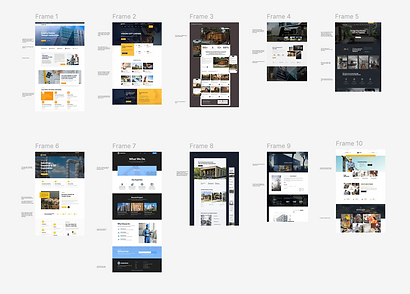
Looking at design inspiration from Pinterest for companies in a similar field to learn mental models and industry design patterns.
Design Research
-
Using stock imagery as a background with text overlayed adds personality to the page but doesn’t use the image as purely decorative. This will help keep the pages short but visually appealing.
-
Use icons to show services and USPs for sacnnability.
-
Show key statistics as a quick way to get buy-in and show respectability.
-
Showing partnerships/accreditations can be done in an on-brand way using grey tints and some transparency.
Logo
Logo Exploration
-
Since this project included doing a refresh of the logo, it was important to nail the logo first so I could use elements from it to develop a visual language for the brand to be used on the refreshed webpages.

Existing logo which had high recognition so needed small developments rather than a complete redesign.
-
I wanted to brighten the gold accent colour and introduce a gradient to add some dimension to the logo and mirror what competitors were doing.
-
Since the client wanted to stay close to the existing logo for continued recognition, I explored subtle changes such as the spacing between the shapes as well as curving the edges slightly.

Logo Development
-
While working on the logos, the company went through some change with the owner’s son joining so they wanted to explore moving further in a direction from John Robinson Associates to JRA.
-
I took the existing logo and looked at more modern typefaces that still had the seriousness of the construction industry. Using an iterative approach, I sketched different lock-ups for the logo including the long name “John Robinson Associates” as well as exploring a shortened more punchy version JRA since the client explained that many of their customers refer to them as JRA.
-
After sharing three concepts with the clients, they liked the experimentation of the JRA shortened version (middle) but liked the version that was closest to their current logo (left).


Images showing initial logo exploration on Illustrator.


-
Through clear updates with the client and open communication we were able to continue working towards the logo they envisioned. It was close with the shortened JRA and updated gradient and logomark shaping. The client emphasised how they wanted the J to be crossed at the top to keep the sense of traditionalism they currently had.


Showing the final development crossing the J.
Final Logo
-
The client was pleased with the final logo and gave the go ahead to start the design of their new website as well as creating the other assets they required.


The final logo and SVG asset to be used on CAD files.
Website
-
The design process began with early concept sketches in Procreate, informed by ongoing conversations with the client to build a clear understanding of their industry, business model, and service offering. This groundwork allowed the core site structure and content hierarchy to be defined early on.
-
Starting with the homepage, wireframes were developed from low to high fidelity, with a focus on translating the refreshed brand into the digital experience. Visual elements from the new identity — including the rounded geometry of the logomark and updated gold colour palette — were intentionally integrated to create a cohesive and recognisable interface.

Sketches for the first draft of the website done on Procreate.


Development of the home page design.
-
A key differentiator for JRA is their role as a consultant throughout the project lifecycle. To reinforce this, FAQs were introduced on the homepage to position JRA as a trusted source of guidance. These were designed as expandable dropdowns to accommodate more detailed responses without overwhelming the page. FAQ content and ordering were refined collaboratively with the client to prioritise the most common and critical questions, particularly for users unsure which services they required.
-
As the design progressed, further clarity was brought to JRA’s service offering. Initially, surveying packages and consultancy were not clearly distinguished; through deeper understanding of the domain, the service pages evolved to clearly articulate both the consultancy-led approach and the range of individual survey services available. This resulted in a clearer, more transparent presentation of how JRA supports clients at different stages.
-
The website designs went through three iterative rounds in Figma before moving into development. As the client was already familiar with Wix and used it for their existing site, the final build was delivered using the same platform to ensure ease of handover, ongoing management, and long-term sustainability.


Development of the services page design.


-
The inclusion of a projects page was necessary to fit with the mental models and competitors designs so that customers could see examples of past work before getting in touch. This section was designed to be straight to the point and highly visual so it could be quickly scanned. This was where some competitors went wrong and went too far into the blog style.
-
Lastly, to push that this was a family business with personalised service that care about their customers, I created a short page showing USPs as well as images of the team to get that across.
-
The key design focus for this website redesign was to look modern and minimalist and I think that was achieved through use of colour and strong structural planning.
Icons designed to portray specialist equipment and services used in utility surveying.


Showing the projects page.

Right showing the About page.
Learning Outcomes
Challenges
Working within a highly specialised and unfamiliar industry required a steep learning curve to fully understand the client’s services and how they were delivered. Early assumptions around how offerings were structured needed to be revisited as my understanding deepened, which required flexibility and close collaboration with the client.
Additionally, evolving requirements and limited initial content meant design decisions had to be made alongside ongoing discovery, reinforcing the need to balance progress with validation as the product definition matured.
What to take to the next project
This project reinforced the value of investing early time in domain understanding, particularly when designing for niche or complex industries. Building knowledge upfront enables clearer information architecture and more confident design decisions later in the process.
It also strengthened my approach to working with evolving requirements by validating assumptions early, designing iteratively, and maintaining close alignment with stakeholders to ensure clarity, usability, and accuracy throughout delivery.


